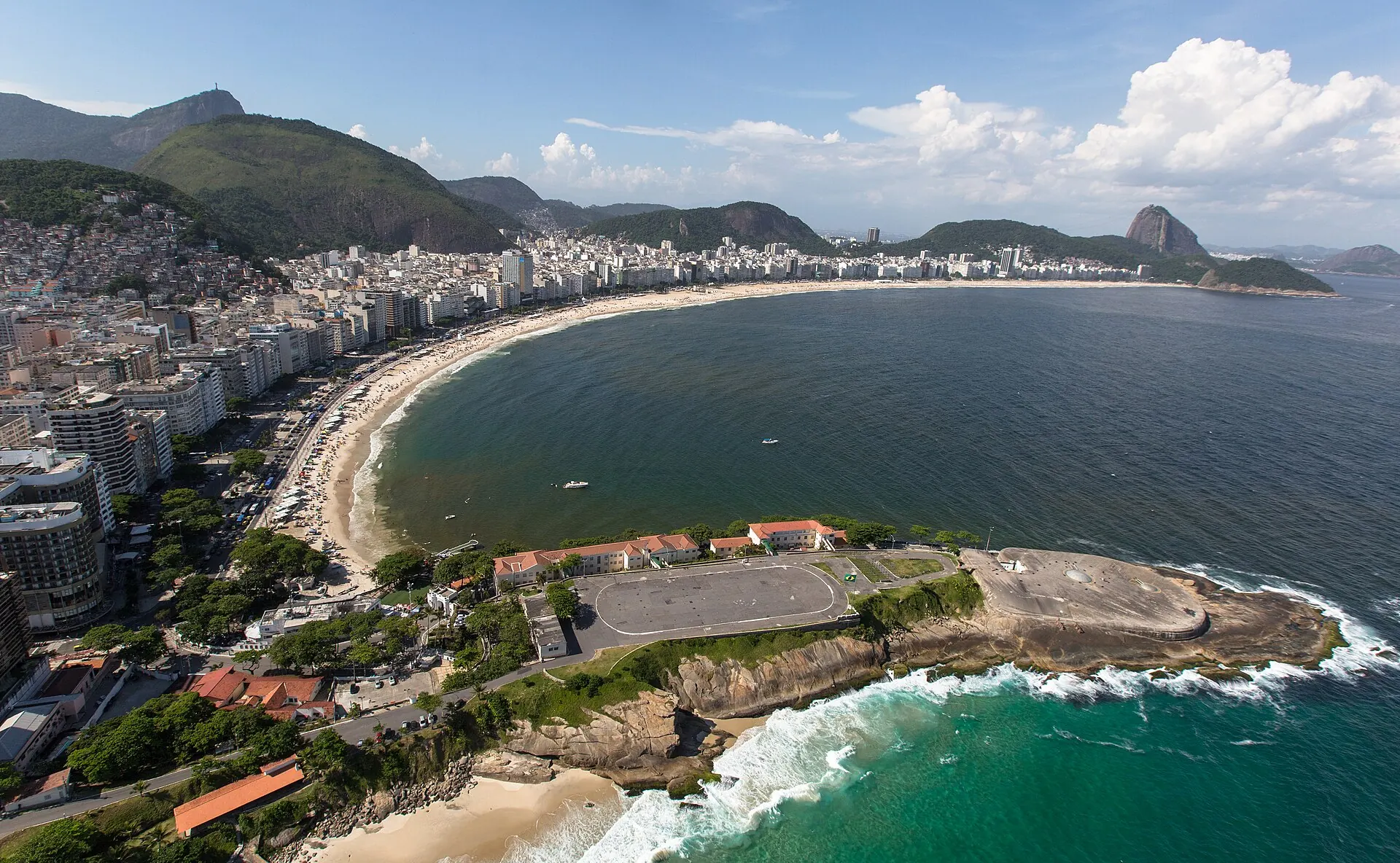
Copacabana beach sweeps in one long curve from the rock at Leme to the fort at Posto 6, with Avenida Atlântica and its patterned promenade running beside it the whole way. It's the beach you'll use every day of a stay on the seafront, and it repays knowing a little more about it: what each stretch is like, who designed the stones under your feet, when the seaside lanes close to cars, and how to read the lifeguards' flags and the water bulletin before you swim.
- Runs
- From Posto 1 at Leme to Posto 6 by the Forte de Copacabana
- Promenade
- Mosaic panels by Roberto Burle Marx, laid in the early 1970s; the wave pattern came from Lisbon
- Sundays and holidays
- Seaside lanes closed to cars from 7am
- Flags
- Green low risk, yellow take care, red stay out, purple jellyfish
- Emergency
- Dial 193 for the fire brigade
- Water quality
- INEA's Boletim de Qualidade das Praias
The beach from Leme to Posto 6
Ask a Carioca where to meet on the sand and the answer will be a posto number. The lifeguard posts are numbered from Posto 1 at Leme to Posto 6 by the Forte de Copacabana, and a military fort stands guard at each end of the beach.
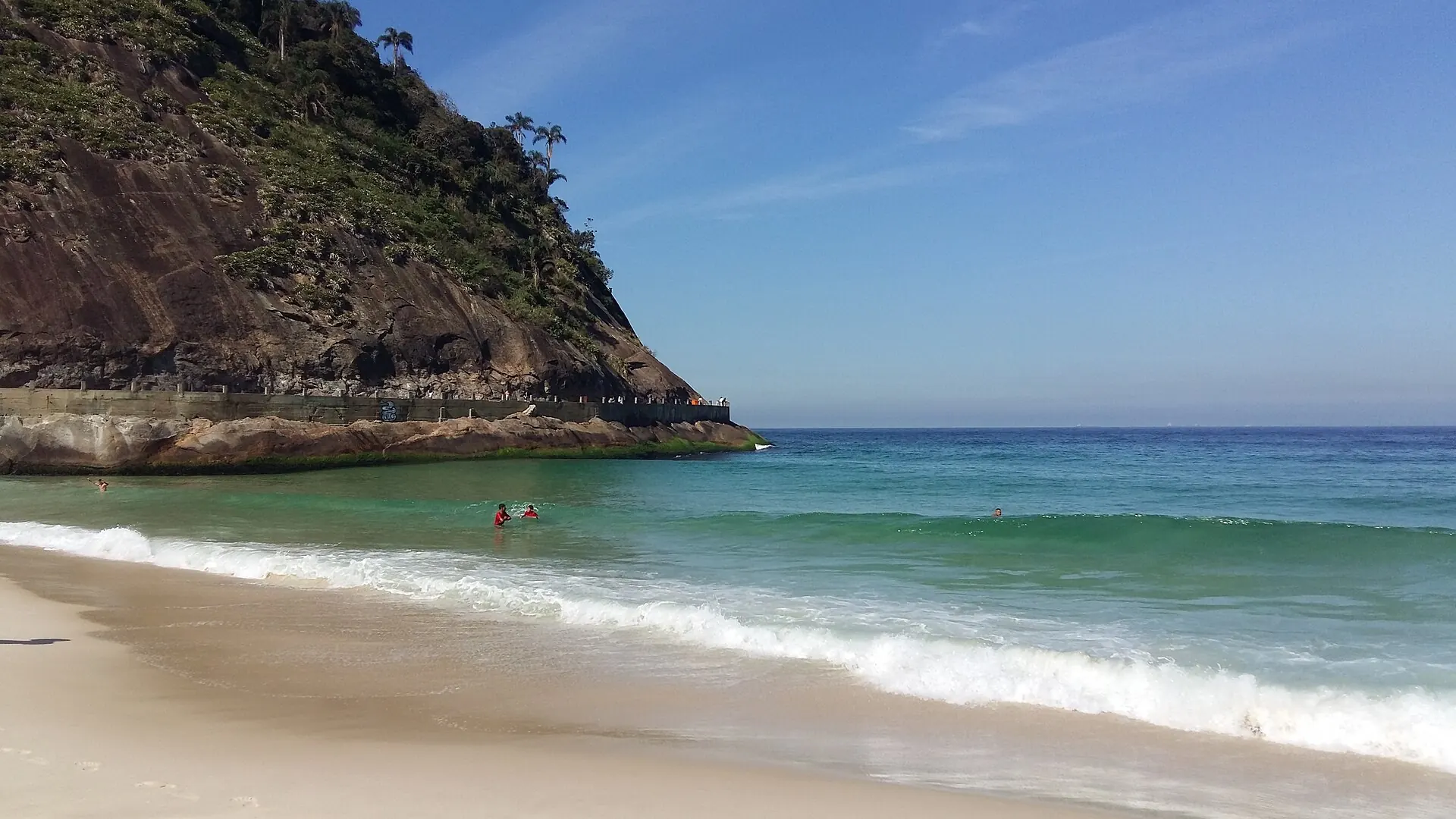
At the northern end, the beach finishes under the forested Morro do Leme, with a walkway where fishermen cast their lines and a cobbled trail that climbs to the Forte Duque de Caxias; our Leme guide covers it. Walking south, the landmark everyone knows is the Copacabana Palace at Avenida Atlântica 1702, which has its own guide. The long middle of the beach is where the city plays: volleyball and footvolley nets, kiosks, the cycle path, and walkers and runners on the promenade from early morning until late at night.
The southern end belongs to the fishermen. In the 17th century this corner was called the Praia das Pescarias, the fishing beach, and the Z-13 fishing colony, officially founded in 1923, still launches its boats from the sand beside the fort and sells the day's catch at its own market there. The fort itself, with its guns and cafés, is in our Forte de Copacabana guide.
The wave pavement and where it came from
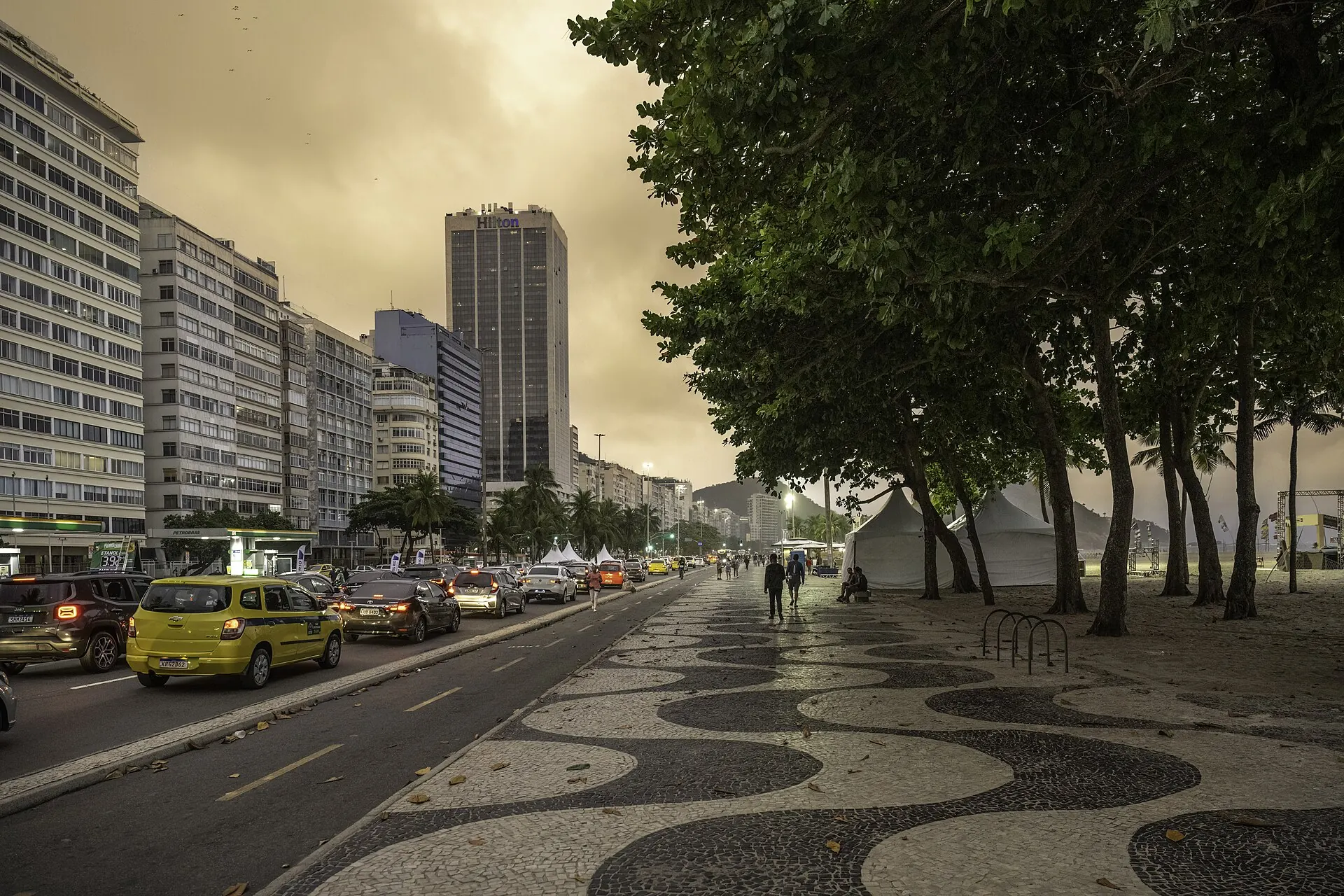
The black and white waves are older than the promenade's famous designer. The pattern, known as Mar Largo, was created in Portugal in the 19th century by the engineer Pinheiro Furtado for Lisbon's Rossio square. It reached Rio in 1905, when Lisbon's city council sent 36 paviors to lay Portuguese stone at the northern end of the new Avenida Central, today's Avenida Rio Branco. Early in the 20th century, Mayor Paulo de Frontin chose the same wave for the seafront of Avenida Atlântica. In Lisbon the design stands for the Tagus running into the ocean; on Copacabana it simply reads as the sea.
What Roberto Burle Marx designed
The promenade you walk today comes from the great works that opened on 15 March 1971, the last day of Governor Negrão de Lima's term. To widen Avenida Atlântica and lay an ocean sewage interceptor, the government pushed the beach about 80 metres out to sea along its whole length, pumping in some 3.3 million cubic metres of sand dredged from Guanabara Bay. The pavement roughly tripled in width, and Roberto Burle Marx was brought in to design it.
Burle Marx designed the large mosaic panels along the building side of the avenue and on the central strip between the carriageways, patterns in Portuguese stone that you take in best from a high window. On the beach side he kept the old wave but turned it, so that it now runs parallel to the sea instead of across it. The work was carried out in the early 1970s, and the state heritage institute, INEPAC, provisionally listed the promenade in January 1991. Later administrations added the cycle path and the tables of bars and restaurants on the pavements, so today's seafront differs a little from the 1971 design.
Keeping it intact is a job of its own: in 2015 the city employed 40 calceteiros, stone pavers trained by specialists from Lisbon, to replace worn stones along the seafront.
Sundays and holidays on Avenida Atlântica
On Sundays and public holidays the seaside carriageway of Avenida Atlântica closes to cars from 7am and becomes a leisure area, with runners, cyclists, skaters and families using the whole width of the road. Traffic moves onto the building-side carriageway, which runs a special Sunday scheme from 7am to 6pm. It's the best time to walk the beach end to end, and the easiest day to cross the avenue with children. Big events, from concerts to the triathlon, bring extra closures, managed by the city's traffic agency, CET-Rio.
Kiosks, the cycle path and sport on the sand
The kiosks on the promenade are run under concession by Orla Rio, a company that grew from a hot-dog stand on Barra da Tijuca beach and has been on the Rio seafront for more than 60 years. They're the easiest place for a cold drink or a bite to eat without leaving the beach. A cycle path runs along the seafront with bike racks on the way, which makes a ride from Leme to Posto 6 an easy morning.
On the sand, volleyball and footvolley, volleyball played without the hands, run from early morning until the light goes. Copacabana has hosted world volleyball championships, world beach soccer championships and events of the 2007 Pan American Games, and on any weekend you can watch very good players for free. For chairs, umbrellas and how the beach-tent system works, see our guide to Rio's beaches.
Lifeguards and flags
The state fire brigade's lifeguards watch the beach from the postos, and their flags are the quickest guide to the sea. Green means low risk. Yellow means medium risk, so swim with care. Red marks a high risk of drowning, and you should stay out of the water. A purple flag warns of marine animals such as jellyfish. The lifeguards also teach people to recognise rip currents, called valas, and to get out of them. Swimming at night is best avoided at any time of year, and in an emergency the number to call is 193.
Settle near a staffed posto, keep small children within arm's reach and ask the lifeguards if you're unsure; they're used to talking to visitors. Our Copacabana safety guide has more tips for the beach and the city.
Checking the water quality
INEA, the state environment agency, publishes the Boletim de Qualidade das Praias, a bulletin that rates each monitored stretch of beach as fit or unfit for swimming. Check your stretch on the morning you plan to swim, along with the lifeguards' flag at the nearest posto.
Walking the promenade end to end
Walking the whole beach takes a relaxed morning. Start at Leme with the fishermen's path, follow the promenade south past the Copacabana Palace, stop for a coconut at a kiosk in the middle, and finish at Posto 6 with coffee at the fort or the rock at Arpoador just beyond. Sundays are best, when the seaside lanes are closed to traffic. If you're staying high up on Avenida Atlântica, as guests of ADV 001 do on its 13th floor, look down in the morning: Burle Marx's panels read best from above. To plan a stay on the beach, contact Art de Vivre.
Questions
Did Roberto Burle Marx design Copacabana's wave pavement?
Not the wave itself. The Mar Largo pattern came from Lisbon's Rossio square and was chosen for Avenida Atlântica early in the 20th century. Burle Marx designed the mosaic panels along the buildings and on the central strip for the works that opened in 1971, and turned the beach-side waves to run parallel to the sea.
When is Avenida Atlântica closed to cars?
On Sundays and public holidays the seaside carriageway closes to traffic from 7am and becomes a leisure area for walking, running and cycling. Cars use the building-side carriageway, which runs a special scheme from 7am to 6pm. Big events can bring extra closures.
What do the beach flags mean in Rio?
Green means low risk, yellow means medium risk so take care, and red means a high risk of drowning, so stay out of the water. A purple flag warns of marine animals such as jellyfish. If in doubt, ask the lifeguards at the nearest posto.
How do I check the sea before swimming at Copacabana?
INEA, the state environment agency, publishes a beach bulletin that shows whether each monitored stretch is fit for swimming. Look at it, and at the lifeguards' flag, on the morning you plan to swim.
What are the postos on Copacabana beach?
They are the numbered lifeguard posts, from Posto 1 at Leme to Posto 6 by the Forte de Copacabana. Cariocas use them as addresses on the sand, so saying you'll be near Posto 6 tells your friends exactly where to find you.
Sources
- INEPAC (Instituto Estadual do Patrimônio Cultural): Calçadão de Copacabana listing
- CBMERJ (Corpo de Bombeiros RJ): beach flags and rip currents
- CBMERJ: World Drowning Prevention Day safety tips (2025)
- INEA: Boletim de Qualidade das Praias (beach bulletin)
- Rio Film Commission (Prefeitura do Rio): Copacabana Beach
- CREA-RJ Ângulos: 50 anos da inauguração da nova Copacabana (2021)
- O Globo: the Copacabana promenade and its Portuguese stone (January 2015)
- Super Rádio Tupi: COR/CET-Rio traffic scheme, Área de Lazer on Avenida Atlântica on Sundays and holidays (2022)
- Folha do Leste: Copacabana closures, Sunday reversible lane 7am-6pm (August 2026)
- Orla Rio: Rio seafront kiosks
- National Geographic Brasil: the last fishermen of Copacabana, Colônia Z-13 (2019)
- Fui Ser Viajante: Forte do Leme and Posto 1 (updated September 2026)
- Visit Rio: Forte de Copacabana, Posto 6
- Copacabana Palace, A Belmond Hotel: hotel overview