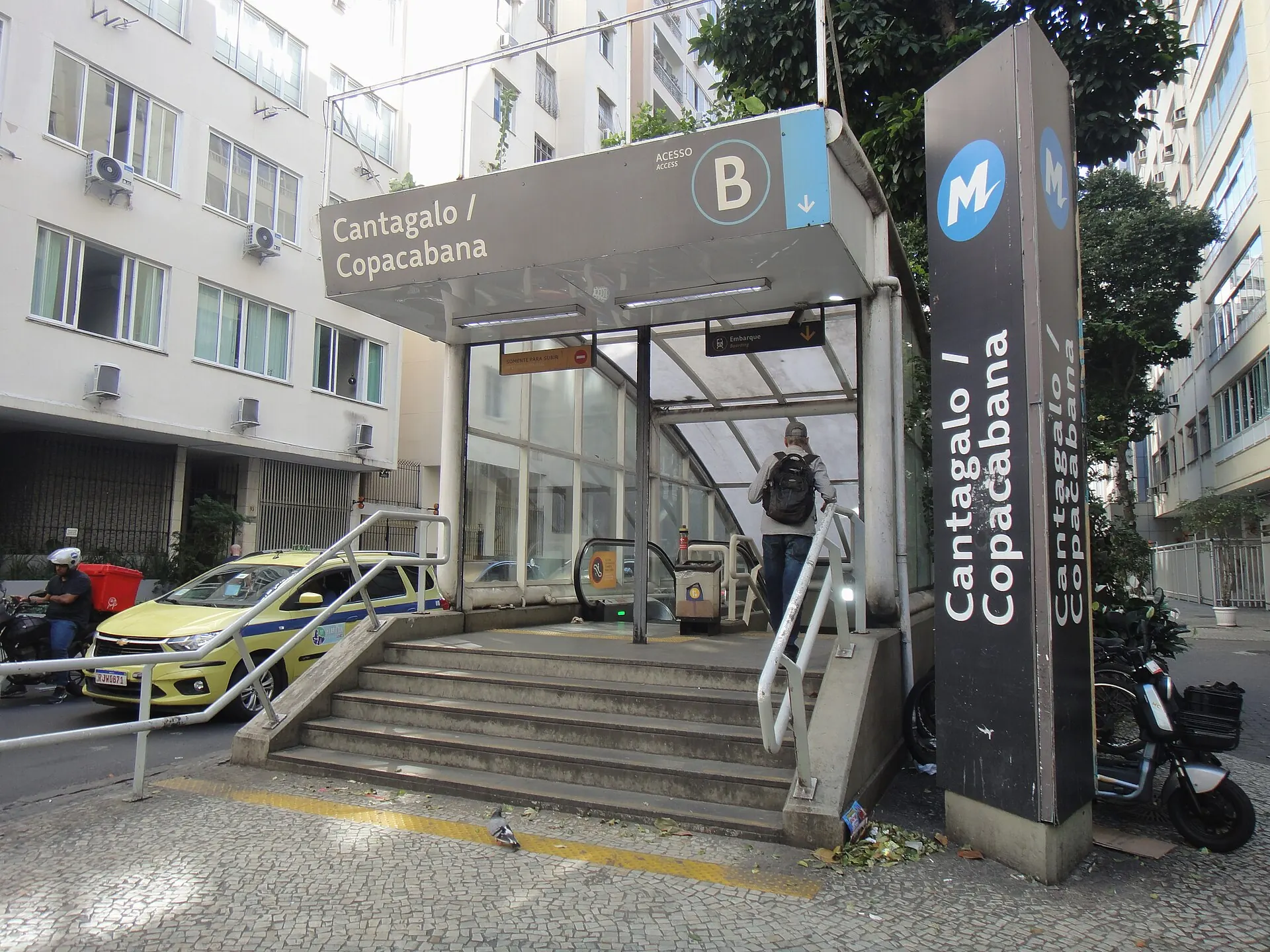
Copacabana is one of the easiest bases in Rio for getting about. Three metro stations sit under the neighbourhood's inner streets, the promenade takes you on foot to Leme, Arpoador and Ipanema, and ride apps work across the city. This guide covers how the metro, the downtown tram, buses, bikes, taxis and the Niterói ferry work in 2026, what they cost, and how to reach Sugarloaf, Christ the Redeemer and the Maracanã without fuss.
- Metro fare
- R$ 7.90 a ride in 2026, on Lines 1, 2 and 4
- Copacabana stations
- Cardeal Arcoverde, Siqueira Campos and Cantagalo (Line 1)
- Metro hours
- 5am to midnight Monday to Saturday; 7am to 11pm Sundays and holidays
- Bus, BRT and VLT fare
- R$ 5.00 a ride since 4 January 2026, paid with Jaé
- Paying by card
- Contactless Visa, Mastercard or Elo, or a phone, at metro gates
- Bike share
- Bike Itaú: from R$ 7.90 a ride or R$ 32.90 for 48 hours
Metro lines and the Copacabana stations
Rio's metro, MetrôRio, has three lines. Line 1 runs from Uruguai in Tijuca through the centre, Flamengo, Botafogo and Copacabana to General Osório in Ipanema. Line 2 starts far out at Pavuna, comes in through Rei Pelé–Maracanã and São Cristóvão, and then shares every station from Central do Brasil to Botafogo with Line 1. Line 4 heads west from Nossa Senhora da Paz in Ipanema through Jardim de Alah and Antero de Quental in Leblon, then São Conrado, to Jardim Oceânico in Barra da Tijuca.
Copacabana has three Line 1 stations, in this order from the Botafogo side:
- Cardeal Arcoverde, the northern station and the closest to Leme.
- Siqueira Campos, in the middle of the neighbourhood, near Rua Barata Ribeiro, Rua Tonelero and Rua Figueiredo de Magalhães. It has two entrances, one on Rua Siqueira Campos and one on Rua Figueiredo Magalhães, with lifts at both, on the mezzanine and down to the platforms.
- Cantagalo, the southern station, nearest the Ipanema side. One stop on is General Osório, the end of Line 1, on the square where the Feira Hippie de Ipanema sets up every Sunday; that station is fully accessible.
The Copacabana stations open from 5am to midnight Monday to Saturday and from 7am to 11pm on Sundays and holidays. To read the signs, you only need the line number and the name of the station at the end of the line you want.
Metro fares and paying by card
A metro ride costs R$ 7.90 in 2026, whatever the distance. A state decree of 10 March 2026 kept it unchanged from 12 April 2026 on Lines 1, 2 and 4.
The easiest way to pay is the card already in your wallet. The gates take contactless Visa, Mastercard and Elo cards, debit or credit, and phones or other devices set up for contactless payment: look for the contactless symbol on the validator, tap and walk through. It's simplest if each adult taps their own card or phone.
The other ways to pay:
- Unitário: a single-journey card sold at the station for R$ 7.90.
- Giro: a rechargeable card that costs R$ 11.90 the first time, made up of a R$ 4.00 refundable deposit and your first R$ 7.90 of travel. Top-ups at station machines and counters have a R$ 5.00 minimum; top-ups in the MetrôRio app or on the Giro website have none.
- QR code ticket: a single ticket bought in the RecargaPay app or at accredited sales points.
- Jaé and Riocard: the city and state transport cards, accepted at every station.
Combined tickets exist too. A metro-plus-BRT journey costs R$ 9.70 on a Jaé card, and you have up to 120 minutes to make the change.
The VLT tram downtown
In the centre and the port district, the light rail is the VLT Carioca, four tram lines that link the places visitors want downtown:
- Line 1 (blue): Santos Dumont airport to Terminal Gentileza.
- Line 2 (green): Praça XV to Praia Formosa.
- Line 3 (yellow): Santos Dumont airport to Central.
- Line 4 (orange): Praça XV to Terminal Gentileza.
Trams run every day from 5am to 11pm, and a ride costs R$ 5.00, the same as the city bus fare since January 2026. Pay with a Jaé card, sold at the self-service machines in VLT stations (Praia Formosa has none) and topped up in the Jaé app, on the Jaé website or at those machines, or with a QR code generated in the Jaé app, a new one for each ride. You pay at one of the validators inside the tram or at the stop, and changing between VLT lines within an hour of your first tap costs nothing extra.
From Copacabana, ride the metro to the centre and pick up the tram there: Line 3 links Central with Santos Dumont, and Lines 2 and 4 both start at Praça XV, where the Niterói ferry leaves. The tram is the easy way around the museums and murals in our Museum of Tomorrow guide.
Buses and the BRT
City buses, the BRT express buses and the VLT have all cost R$ 5.00 a ride since 4 January 2026, when the fare went up from R$ 4.70. They run on Jaé, the city's digital ticketing system: carry a Jaé card, or skip the card and pay with a QR code from the Jaé app. Buses go almost everywhere, but the routes take some learning and traffic slows them at rush hour, so the metro and ride apps are simpler for most trips; save the bus for short hops along the beach roads. The BRT matters if you're heading west towards Barra da Tijuca and beyond: Line 4 of the metro takes you as far as Jardim Oceânico, and a combined metro and BRT trip costs R$ 9.70 on Jaé.
Ride apps and taxis
Uber works across Rio, including pickups at Galeão airport, and its Reserve option lets you book a car up to 30 days ahead, which is handy for an early flight. A ride app shows the price before you get in and tracks the route, which makes it the easy choice at night, with luggage or with children. Yellow street taxis are easy to flag down on Avenida Atlântica and the main inner streets. Keep your phone out of sight while you wait on the pavement; our note on safety in Copacabana has more.
For a day with a car and driver, or a driver who doubles as a guide, the Art de Vivre concierge arranges it, and it can be set up before you land if you write to us. Flights in and out are covered in our airport guide.
Bike Itaú and the cycle paths
The shared bikes in docks along the beachfront belong to Bike Itaú, Rio's bike-share scheme, with more than 430 stations and about 4,800 bikes across the city. Download the Bike Itaú app, register, choose Rio de Janeiro, pick a plan, then unlock a bike by scanning the QR code the app gives you.
- Single ride: from R$ 7.90 for one trip of up to 15 minutes on a standard bike, with extra minutes charged after that.
- 48-hour pass: from R$ 32.90, with up to four rides a day on standard bikes, of up to 60 minutes on weekdays and up to two hours at weekends; electric bikes are charged by the minute on top.
The app places a temporary R$ 20 hold on your credit card, released within seven days if you don't run up extra charges. The flat beachfront cycle path is the obvious ride. The other favourite is the 7.8 km path around Lagoa Rodrigo de Freitas, a short ride inland from Ipanema; the Botanical Garden guide covers the lagoon loop.
The ferry to Niterói
The ferries across Guanabara Bay leave from Praça XV, in the centre, for Praça Araribóia in Niterói, the city on the far shore. The fare went up from R$ 4.70 to R$ 5.00 in early February 2026, under a state decree published on 8 January 2026 that took effect 30 days later, so the crossing costs about the same as a bus. It's a cheap way out onto the water, with the city behind you. Take the metro to the centre and the VLT to Praça XV, where Lines 2 and 4 both end. For the bay on a private boat, with a skipper and your own route, the concierge books charters from the marinas.
Walking the beachfront
For a good part of your stay you won't need transport at all. The promenade on Avenida Atlântica runs the length of Copacabana beach on its black-and-white wave pavement, from Leme in the north to the fort on the headland at the southern tip; beyond the fort, Arpoador and then Ipanema are a short walk away. Early morning and the hour before sunset are the pleasant times to walk. At midday, carry water and a hat. Our guides to the beach and its promenade, Leme and Arpoador cover each stretch.
Reaching Sugarloaf, Christ the Redeemer and the Maracanã
Each of the three big sights is a different trip from Copacabana:
- Sugarloaf: the cable car leaves from Avenida Pasteur 520 in Urca, a short taxi or app ride from Copacabana. It runs from 8.30am on weekdays and from 7.30am at weekends until 9pm, with the last boarding at 7.30pm. More in our Sugarloaf guide.
- Christ the Redeemer: the rack railway has carried visitors up from Rua Cosme Velho 513 since 1884; book a date and a boarding time online. The official vans leave from Copacabana, Largo do Machado and the Paineiras visitor centre, and the van ticket covers the ride back to where you boarded and entry to the monument. In October 2026 a same-day adult train ticket was R$ 134; check the current price. At the top, the escalators have been switched off since 3 August 2026 while new ones go in, a job expected to take about ten months; visits carry on, with free stair-climbing chairs for people with reduced mobility. Our Christ the Redeemer guide lists every route up.
- The Maracanã: take Line 1 from Copacabana to Botafogo, or to any shared station up to Central, switch to Line 2 (towards Pavuna) and leave at Rei Pelé–Maracanã; Access A is the exit for the stadium. On Sundays and holidays that entrance opens at 7am and closes at 11pm. Tours and match days are in our Maracanã guide.
Questions
How much does the Rio metro cost in 2026?
A single metro ride costs R$ 7.90 in 2026 on Lines 1, 2 and 4, whatever the distance. A state decree of 10 March 2026 kept the fare at that level from 12 April 2026. Contactless cards and phones are accepted at the gates, or buy a single-journey Unitário card at the station.
Can I pay for the Rio metro by tapping my card?
Yes. The gates accept contactless Visa, Mastercard and Elo cards, debit or credit, and phones or other devices set up for contactless payment. Look for the contactless symbol on the validator and tap. If your card is refused, buy a Unitário single-journey card at the station for R$ 7.90.
What time does the metro open and close?
The Copacabana stations open from 5am to midnight Monday to Saturday and from 7am to 11pm on Sundays and holidays. On nights with very large events, check MetrôRio's website for special hours before you count on a late train.
How do I get from Copacabana to the Maracanã by metro?
Take Line 1 towards the centre, change at Botafogo or any other station shared with Line 2 up to Central, and ride Line 2 towards Pavuna as far as Rei Pelé–Maracanã, and use Access A for the stadium. The fare is R$ 7.90 in 2026, change included.
Does the metro go to the airport?
No metro station serves either airport. The VLT tram reaches Santos Dumont, the downtown airport, on Lines 1 and 3. For Galeão, the usual choices are a ride app, a taxi or a pre-booked transfer; our airport guide compares them.
Is Bike Itaú easy to use as a visitor?
Yes, if you have a smartphone and a credit card. Download the Bike Itaú app, register, choose Rio de Janeiro and pick a plan: a single ride starts at R$ 7.90 for up to 15 minutes and a 48-hour pass at R$ 32.90. The app holds R$ 20 on your card, released within seven days if unused.
Sources
- MetrôRio: meios e tarifas (fares and ways to pay, 2026)
- MetrôRio: pagamento por aproximação (contactless payment)
- MetrôRio: interactive network map
- MetrôRio: Cardeal Arcoverde station
- MetrôRio: Siqueira Campos station
- MetrôRio: Cantagalo station
- MetrôRio: General Osório station
- MetrôRio: Rei Pelé – Maracanã station
- VLT Carioca: lines, fare and hours
- VLT Carioca: guia de uso (how to pay and ride)
- Poder360, 30 December 2025: Rio bus fare rises to R$ 5 from 4 January 2026
- Jaé, Rio's digital ticketing system
- Bike Itaú Rio: plans and prices
- Folha do Leste, 8 January 2026: ferry fares rise from February
- Uber: Rio de Janeiro city page
- Parque Bondinho Pão de Açúcar: address and hours
- Trem do Corcovado: station and tickets
- Paineiras Corcovado: official vans to Christ the Redeemer
- ICMBio, 2 July 2026 (updated 28 October 2026): Alto Corcovado works and escalator replacement